A Note on Scripture
Ethiopian Eunuch

For two months, I have been reading aloud and interpreting The Acts of the Apostles for my Sunday School students in Seattle. I primed them with the idea that while the main character is always and everywhere God, in scripture, Paul, once Saul of Tarsus, is a close side-kick of the main character. And he is the real twelfth apostle of the Lord Jesus, not Matthias. The numbering is a bit funny. With Judas Iscariot and Matthias, you could call Paul the 14th apostle. He is the last of all, and yet the greatest.
According to Acts, Judas Iscariot seems to kill himself in Ἁκελδαμά (Lachmann) aceldama (Aramaic transliterated into Greek then into English in the KJV; versus the Ge’ez equivalent ሐቅለ ደም haqle dem), a field of blood. The twelve is a phrase repeated religiously till Chapter 6, after which it withers away—unlike the state in communism. Matthias is selected by the casting of lots, prior to Pentecost (when the apostles received the Holy Ghost). God is not a genie (jinni) you can seal inside of a Magic 8 Ball. He is not mocked. He laughs last, and first. The selection of Matthias was the will of man, and not the will of God. The selection of Paul was the will of God. And chapters 1-8 are constantly foreshadowing his forceful and everlasting conversion to The Way in chapter 9.

Here is Chapter 8 in the KJV:
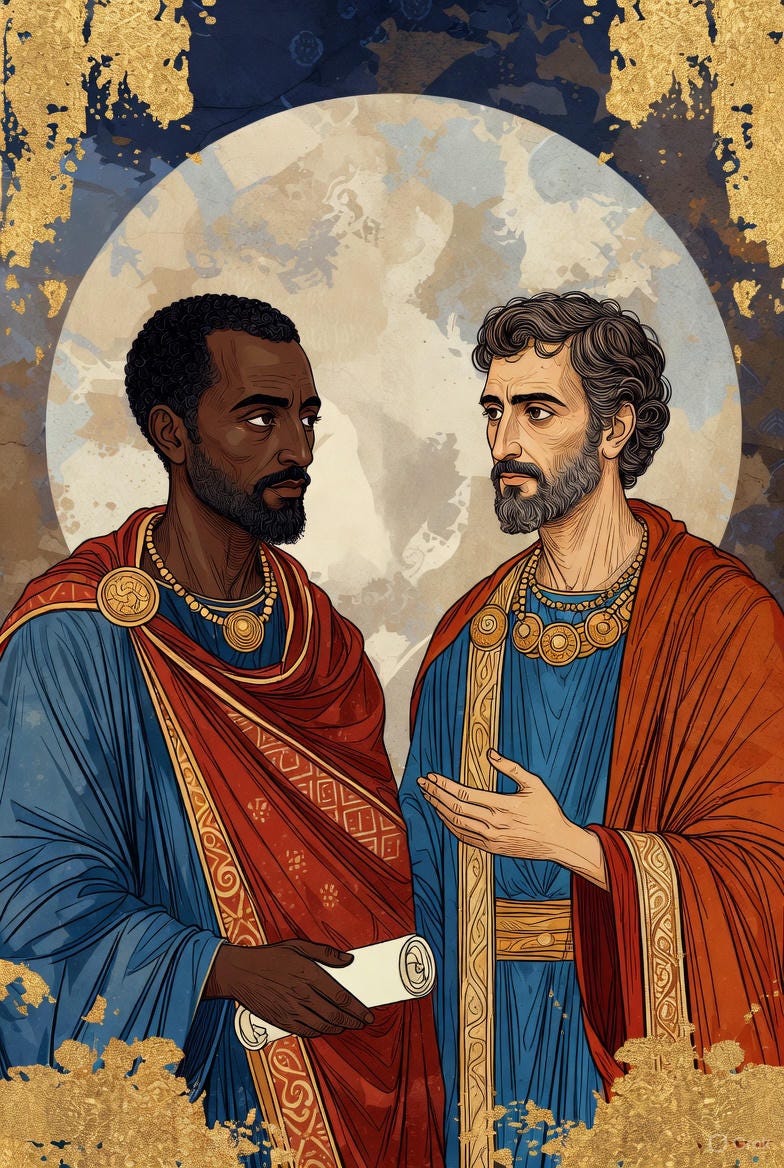
And Saul was consenting unto his death. And at that time there was a great persecution against the church which was at Jerusalem; and they were all scattered abroad throughout the regions of Judaea and Samaria, except the apostles. And devout men carried Stephen to his burial, and made great lamentation over him. As for Saul, he made havock of the church, entering into every house, and haling men and women committed them to prison. Therefore they that were scattered abroad went every where preaching the word. Then Philip went down to the city of Samaria, and preached Christ unto them. And the people with one accord gave heed unto those things which Philip spake, hearing and seeing the miracles which he did. For unclean spirits, crying with loud voice, came out of many that were possessed with them: and many taken with palsies, and that were lame, were healed. And there was great joy in that city. But there was a certain man, called Simon, which beforetime in the same city used sorcery, and bewitched the people of Samaria, giving out that himself was some great one:To whom they all gave heed, from the least to the greatest, saying, This man is the great power of God. And to him they had regard, because that of long time he had bewitched them with sorceries. But when they believed Philip preaching the things concerning the kingdom of God, and the name of Jesus Christ, they were baptized, both men and women. Then Simon himself believed also: and when he was baptized, he continued with Philip, and wondered, beholding the miracles and signs which were done. Now when the apostles which were at Jerusalem heard that Samaria had received the word of God, they sent unto them Peter and John: Who, when they were come down, prayed for them, that they might receive the Holy Ghost: (For as yet he was fallen upon none of them: only they were baptized in the name of the Lord Jesus.) Then laid they their hands on them, and they received the Holy Ghost. And when Simon saw that through laying on of the apostles’ hands the Holy Ghost was given, he offered them money, Saying, Give me also this power, that on whomsoever I lay hands, he may receive the Holy Ghost. But Peter said unto him, Thy money perish with thee, because thou hast thought that the gift of God may be purchased with money. Thou hast neither part nor lot in this matter: for thy heart is not right in the sight of God. Repent therefore of this thy wickedness, and pray God, if perhaps the thought of thine heart may be forgiven thee. For I perceive that thou art in the gall of bitterness, and in the bond of iniquity. Then answered Simon, and said, Pray ye to the Lord for me, that none of these things which ye have spoken come upon me. And they, when they had testified and preached the word of the Lord, returned to Jerusalem, and preached the gospel in many villages of the Samaritans. And the angel of the Lord spake unto Philip, saying, Arise, and go toward the south unto the way that goeth down from Jerusalem unto Gaza, which is desert. And he arose and went: and, behold, a man of Ethiopia, an eunuch of great authority under Candace queen of the Ethiopians, who had the charge of all her treasure, and had come to Jerusalem for to worship, Was returning, and sitting in his chariot read Esaias the prophet. Then the Spirit said unto Philip, Go near, and join thyself to this chariot. And Philip ran thither to him, and heard him read the prophet Esaias, and said, Understandest thou what thou readest? And he said, How can I, except some man should guide me? And he desired Philip that he would come up and sit with him. The place of the scripture which he read was this, He was led as a sheep to the slaughter; and like a lamb dumb before his shearer, so opened he not his mouth: In his humiliation his judgment was taken away: and who shall declare his generation? for his life is taken from the earth. And the eunuch answered Philip, and said, I pray thee, of whom speaketh the prophet this? of himself, or of some other man? Then Philip opened his mouth, and began at the same scripture, and preached unto him Jesus. And as they went on their way, they came unto a certain water: and the eunuch said, See, here is water; what doth hinder me to be baptized? And Philip said, If thou believest with all thine heart, thou mayest. And he answered and said, I believe that Jesus Christ is the Son of God. And he commanded the chariot to stand still: and they went down both into the water, both Philip and the eunuch; and he baptized him. And when they were come up out of the water, the Spirit of the Lord caught away Philip, that the eunuch saw him no more: and he went on his way rejoicing. But Philip was found at Azotus: and passing through he preached in all the cities, till he came to Caesarea.
Here are my interpretations thereof:
What is a Eunuch? Why does Acts include the Ethiopian Eunuch?
The Ethiopian is the Kushite is the Meroe Civilization product is the Nubian is the Sudanese etc. But the Ethiopian is also a standin for all dark-skinned peoples, especially the near-by burgeoning habesha (Aksumite) civilization. And is the example par excellence of the Other (extreme stranger). God is the god of all, not the minor deity of a particular ghetto.
Saul sedadee (The Persecutor unto death or diasporic exile)
1-3
-Saul agrees with the murder (stoning to death) of Stephen
-The Church in Jerusalem was diaspora-ed (turned into a diaspora; scattered like seeds; zrwet); except the apostles
-a liturgy of death is had for Stephen (akleelu; The Crown) (people endlessly debate tselote fithat and toll houses, but it is inhuman and ahistorical to have no liturgy of death, and it is biblical to pray for the dead; 2 Maccabees 12:39–46 and John 10:22)
-Saul went hunting for more Christians to persecute
Philip heralds The Anointed One in Samaria
4-8
-The scattered ones (diasporic ones) herald the good news
-What is the importance of Samaria? They are the close stranger or near-pear. They worship yahweh elohym, accept the Five Books of Moses (the five fingers of death and life), but they do so only in the geography they are comfortable with, on Mt. Gerazim! Their alphabet matches the Paleo-Hebrew found in some (4Q11) of the Dead Sea Scrolls, as opposed to the Babylonian Exile Aramaic script that they had assimilated to and still use to this day. The inclusion of the Samaritans, the close Other, demonstrates again that God is the god of all.
Simon the Illusionist
9-25
-Simon the Illusionist perceives greatness with magic and miracles (like fellow illusionists David Blaine; David Copperfield, Harry Houdini, and Alexander the Man Who Knows)
-He seeks attention for himself rather than pointing toward God (like many fake exorcists today, even though there are real demons and real exorcists)
-Jesus only (like the sect of the ironically named former Prime Minister Haylemaryam Desaleñ of Ethiopia) baptisms have added to them later the Holy Ghost
-Simony, the eponymous sin of cash for ordination, sadly happens in real life today as it did then. As it comes from Simon the Illusionist, babbling comes from the Tower of Babel (Gen. 11), and שבלת s(h)ibboleth (ש sheen is tricky; all that glisters is not gold) (sloganeering; demagoguery; sophism) comes from Judges 12:5–6
-This is peak! Simon Peter says to Simon the Magic Man, be destroyed with your money (for you cannot serve God and Mammon)! This reminds the savvy reader of the parallel dichotomy between Jesus, a true Son of the Father, and Bar Abbas, a false son of the Father, the Radical. Simon Peter is the one who cites this evidence earlier in Acts 3:13–14 LEB “The God of Abraham, and of Isaac, and of Jacob, the God of our fathers, has glorified his servant Jesus, whom you handed over and denied in the presence of Pilate, after he had decided to release him. But you denied the Holy and Righteous One and demanded that a man—a murderer—be granted to you.”
-Simon tells Simon to repent of envy
-Simon the Sinner asks for the intercession of Saint Simon. As when I read aloud Job, I would like to ask my low-chuch (‘non-denom’) Protestant friends why he does not just pray to God himself?
Philip and the Ethiopian Eunuch
26-end
-melak yahweh (angelos kyrios) tells Philip to go to The Road (The Way) in the Desert (Wilderness) (these are parallel synonyms for Christianity)
-Chief Treasurer Ethiopian Eunuch worships God in Jerusalem like the God-fearing Centurion Cornelius of the upcoming Acts 10
-reading aloud (the opposite of a selfish act) the Scroll of Isaiah (dereq hadees or dry New Testament). If you had to only read three scrolls of the Hebrew Bible, read Genesis, Isaiah, Psalms, and search for Christ in them; praying that the Most High God reveals him to you in them)
-How could I understand without a guide? Read commentaries of the Latin, Greek, Syriac, Coptic, Armenian, and Ge’ez Church Fathers across the aeons, beginning with the first aeon of Christianity. The saame suggestion is commonly made of all the Great Books (from Plato to Shakespeare to Frankenstein to 1984).
-Isaiah 53:7-8 (an invitation to read the whole chapter and indeed the whole scroll, again and again) is quoted. This suffering servant passage is the number one converter of Jews. It is beyond a reasonable doubt written about Jesus Christ, or some Christ/Messiah/Anointed One yet to come. But it cannot be reasonably ignored.
-His greatness is not in magic and miracles, but in loving weakness and submission
-This immediate baptism request from an extreme Other and person in a position of power, after one interpretation from a student of the apostles, should transform us all into passionate catechists.
-Like Samaritan Christians, the Ethiopian Eunuch went on his way rejoicing (and as it is written in Galatians 4:27 which quotes Isaiah 54:1 LEB (which is right after the Suffering Servant passage) “Sing for joy, barren woman; who has not borne! Burst forth into rejoicing and rejoice, she who has not been in labor! For the children of the desolate woman are more than the children of the married woman,” says Yahweh.”
-Then, Philip kept on heralding! And so should we.