he laughs

As I wished the New Calendarists a blissful feast, so too I wish the Old Calendarists a blissful feast of the translation and ascension (going up) of the Holy Virgin Mary!
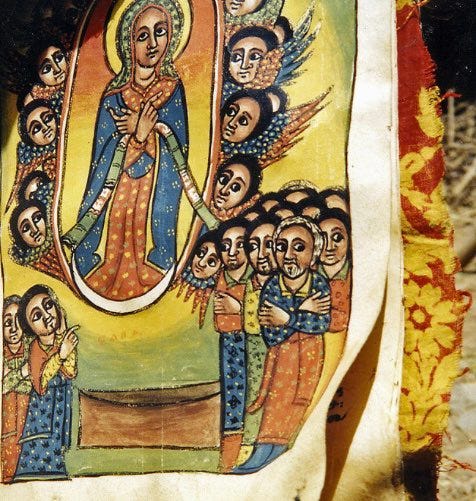
There is this quip that some American Christians (Protestant and influenced by Protestants) get used to saying and say with such frequency that they are not beating the NPC allegations. The rote script tells them to say, “that is not in the bible.” A lot of things are not in the bible. The early church fasted on Wednesdays and Fridays, and we still do too. We know this not from the bible, but from a 1st or 2nd Century A.D. document called the didache. Though American Christians likely do not fast with regularity on Wednesdays and Fridays, surely all but the Seventh Day Adventists worship on Sunday. Where in the bible does it tell you to do that? Nowhere. Again, the didache does. And so do other early church fathers.
The translation and ascension of Theotokos (the Mother of God) is not explicitly in the bible, rather the 3rd Century A.D. Liber Requiei Mariae (The Book of Mary’s Falling Asleep) and works like it that arose after. But that is not a problem. Drawing on the Antiochene School of Biblical Exegesis and the Alexandrine School of Biblical Exegesis we can teach and preach about her translation and ascension using scripture. Remember, the early church did not ratify the canon of the New Testament till the 4th Century A.D. In the interim period Christians were being born of the Spirit from hearing homilies regarding Christ interpreted exclusively from the Old Testament or Hebrew Bible.
he who sits in the sky shall laugh
Psalms 2:4
ዘይነብር፡ውስተ፡ሰማይ፡ይሥሕቆሙ
ze’ynebr wste semay ysihiqomu
Heroes and villains are in a constant game of cat-and-mouse to see who gets the last laugh. As human beings, we are too. We have to be very careful not to laugh at God. This was Sarah’s sin. First she tried to circumvent nature by having Abraham bring forth a son through their handmaiden Hagar. But Ishmael, though heard by God, was not the child of promise. God always has the last laugh. So, in Genesis (berashyt; in the beginning), God has the child of promise named Isaac (he laughs).
Since Ge’ez (Classical Ethiopic) and Amharic (Neo-Ethiopic) are semitic tongues, we have the accident of hearing this original haymaker of scripture not only in Genesis but in the Psalms. But since neither Ge’ez nor Amharic have the last laugh when it comes to scripture, we must look at the Biblical Hebrew (which is originally consonantal rather than vocalized).
יושב בשמים ישחק
yosheb be’s(h)emaym ys(h)khaq
The savvy reader will see not one but two cognates. The word for sky/skies/heaven/heavens is the same. Functionally, that place above which is out of reach of humankind. Set aside the aerospace engineers and astronauts of today, and remember the Tower of Babylon in Genesis 11. The second is the word which means he laughs. This word could be the function of laughing, or the person of Isaac, the child of promise.
Now, let us return to the psalm:
he who is enthroned in the heavens is Isaac
The Lord Jesus Christ, the Son of God and the Son of the Virgin Mary, is the second Isaac, a sacrificial lamb born of the promise of God alone and not the will of man. Through his ascension and sitting (being enthroned) at the right hand of his Father prior to his second coming to judge the living and the dead, the seed of Abraham has returned humanity to paradise.
And through the ascension of his mother, our Lady, we have a second confirmation that humanity has returned to paradise. O the joy! O the hope! You too have been promised to return to paradise, and these are the first fruits of his resurrection. And there will be many more.
Let us call again upon our friend amongst the Syriac saints, Mar Jacob of Serug, to guide us in reflecting upon her glorification.
On this day Adam rejoices and Eve his wife, because their daughter rests in the place where they are gathered.
On this day the righteous Noah and Abraham rejoice that their daughter has visited them in their dwelling-place.
On this day Jacob, the honorable old man, rejoices that the daughter who sprouted from his root has called him to life.
On this day the twelve just sons of the lame [one] rejoice greatly and are glad in that she visited them.
On this day let also Judah rejoice greatly, for behold the daughter who has given life went forth from his loins.
On this day let Joseph rejoice, and the great Moses, for one young maiden has called all mankind to life.
On this day let Aaron rejoice and Eliezer and all the tribe of the sons of Levi with their priesthood.
On this day let David, the renowned forefather, rejoice, because the daughter who was from him has placed a glorious crown on his head.
On this day let Samuel rejoice with Jeremiah, because the daughter of Judah dropped dew on their bones.
Come Ezekiel, trained in prophetic revelation, if the thing that has occurred is described in your prophecy!
On this day let also Isaiah the prophet rejoice, because she whom he prophesied, behold, she visits him in the place of the dead.
On this day all the prophets lifted their heads from their graves, because they saw the light that shone forth on them.
On the Mother of God (pgs. 87-88). Mary T. Hansbury (1941-2021).