Moses the Black
a film review

Editorial note:
The film features a fictional Greek Orthodox funeral which is shotup in Chicago, America’s third largest city. When I moved to the much smaller Seattle in mid-2024 a real Ethiopian Orthodox funeral was shot up for similar reasons of payback that are in the film. At the end of January 2026, just down the street from the high school I teach at in Seattle’s Rainier Beach neighborhood, two high school students (TS and TH) were shot dead at a bus stop on Rainier Avenue South and South Henderson Street, that I drive by daily and walk by sometimes. We live in a simulation. But it is run by God. Evil exists because God wills us to be free to choose.
When the real funeral in 2024 was shotup, our archdiocese’s archbishop, his beatitude Aba Mark, filled with grief and the Holy Ghost, told me to take care of the children of his archdiocese as if they were my own. And so his saying would pierce my heart, he first referenced my only-begotten son whom he plays with regularly. I take his words seriously. And have been teaching scripture for going on two years in Seattle’s Central District. And have connected this ministry to OCPM (Orthodox Christian Prison Ministry), upon the recommendation of my friend Matthew Namee who runs OSI (Orthodox Studies Institute) which recently employed my other friend Dcn. Seraphim aka Richard Rohlin.
Moses the Black is a film in this vein which can take care of the children. Though I critique the visions of the desert from the city, the best line comes from a conversation between the protagonist Malik and St. Moses the Black.
Malik: What’s your secret?
Aba Moses: Go sit in your cell. And your cell will teach you everything.
There is an unmissable parallel between Malik’s prison cell and Aba Moses’ monastic cell. What is your cell? Your cell is your locale. Change starts with you and will flow into your locale.
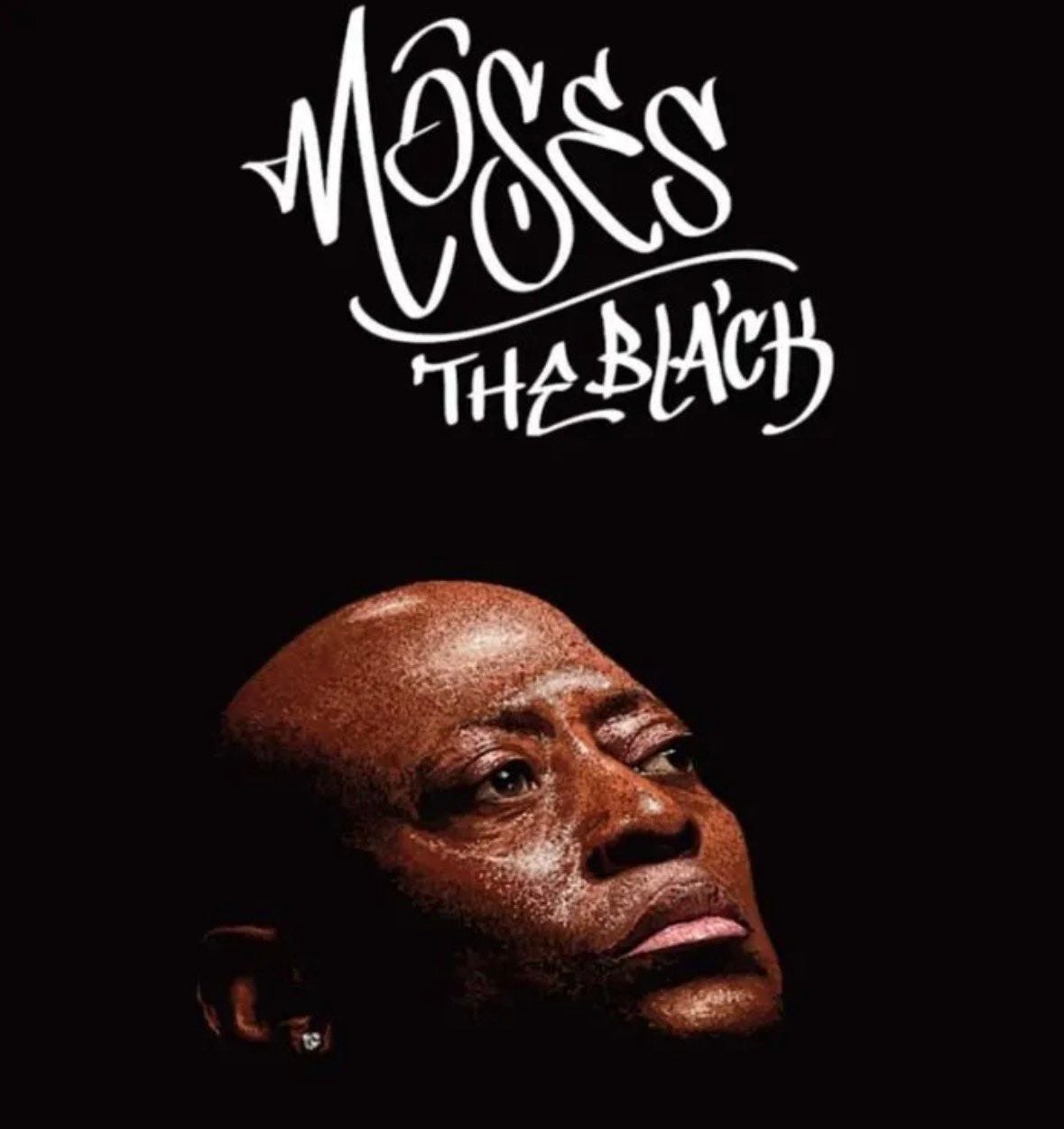
Moses the Black (2026; not to be mistaken for The Black Moses (2012); a fever nightmare for linguists and philologers), a film about the eponymous Northeast African saint, fuses together American street culture epitomized by Chicago and the desert of The Desert Fathers. My college roommate of two non-consecutive years (shoutout to Alex) guided me, in college, through legendary Japanese filmmaker Akira Kurosawa’s three Shakespeare adaptations: Throne of Blood (1957), based on Macbeth (1606); The Bad Sleep Well (1960), based on Hamlet (1601); and Ran (1985), based on King Lear (1605). These adaptations from one setting to another still stand superlatively in the eye of my heart. Other reviewers of Moses the Black have referenced the glaring twinning of this film and Spike Lee’s Chi-raq (2015), “a modern day adaptation of the ancient Greek play Lysistrata by Aristophanes.” They are literally set in the same city, and focus on the same ADOS/FBA (African Descendant of Slaves, Foundational Black American) demographic. Moses the Black’s failure is in not committing to a total adaptation. Instead, we had a disjointing back-and-forth between Chicago and Ethiopia (Kush, Nubia, Meroe, Upper Egypt, The Sudan etc.). The thespianry of the main white dirty cop was also over-the-top. Everything else is a success.
Or so I say. Whereas Rotten Tomatoes critics gave Chi-raq an 82% and the vox populi said 53%, the critics there gave Moses the Black a 23% and the vox populi said 78%. The New York Times was not favorable to Moses the Black either in their review. This phenomenon reminds me of the mixed critical reception of Ms. Lauryn Hill’s (my fellowlaborer) MTV Unplugged No. 2, a low-church prophetic and personal scriptural album which directly succeeded her RIAA Diamond-certified The Miseducation of Lauryn Hill. Touré, writing in Rolling Stone, shares an anecdote about a music industry executive thinking aloud about self-defenestration in response to the album.
“So the devils besought him, saying, if thou cast us out, suffer us to go away into the herd of swine. And he said unto them, go. And when they were come out, they went into the herd of swine: and, behold, the whole herd of swine ran violently down a steep place into the sea, and perished in the waters” (Matthew 8:31-32)
“Resist the devil, and he will flee from you” (Jacob 4:7).
“I ain’t here to argue about His facial features,
Or here to convert atheists into believers,
I’m just tryna say the way school need teachers,
The way Kathie Lee needed Regis, that’s the way I need Jesus,
So here go my single, dawg, radio needs this,
They say you can rap about anything except for Jesus,
That means guns, sex, lies, videotape,
But if I talk about God, my record won’t get played, huh?
Well, if this take away from my spins,
Which’ll probably take away from my ends,
Then I hope it take away from my sins”
-pre-Donda West passing Old Kanye
My contention is that the subject matter of Moses the Black bothers people who do not want to think about God. To watch this film is to be compelled to think critically, as I did in college (at my low-church Christian liberal arts alma mater in SoCal) for the first time, about your life, your sins, and whether or not you should seek μετάνοια (metanoia; tactfully only rendered in dynamic translation as change of the heart in the film) and pursue it. 50 Cent (who has been on a generational run: Moses the Black, Sean Combs: The Reckoning the Diddy Documentary, DoorDash The Big Beef Super Bowl LX Campaign, ROI on an AI investment, multi-million dollar investment in Shreveport, Louisiana, and the forthcoming Street Fighter film), the executive producer of the film, explicitly removed the just and right title of St. as a prefix to Moses so that the moral of the story does not feel like a bludgeon to the head of the viewers. Yelena Popovic (no known relation to “winningest coach with a single franchise in NBA history” (AP) Gregg Popovic, even though he was born in Chicago), the director and writer, kept the script under wraps for eons so that evil eyes would not try to reduce the rawness and ruggedness of the story, thus diminishing its power to change hearts. One of her only confidants was Serbian Orthodox priest Fr. Turbo Qualls, an ADOS/FBA tattooist turned iconographer and actor (as himself) in this film. Fr. Turbo made the cut as confidant and actor because he shared Yelena’s love of Orthodoxy and love of good storytelling. This is a point my friend Jonathan Pageau has made many times. Curtis Yarvin has made this point about right-wing film as well. And before them, this point separated J.R.R. Tolkien from his friend C.S. Lewis. The primary goal of an artist should be to make the highest quality art. The moral of the story should come secondarily and organically with as much subtlety as Solomonid Dynasty Era Ethiopian palace intrigue.
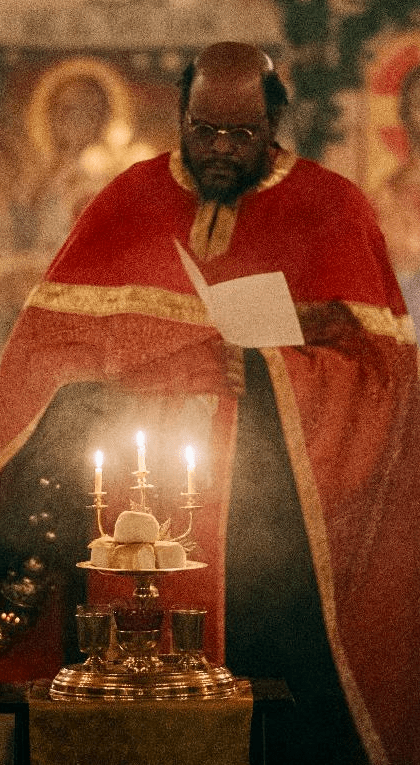
Moses the Black features: blood-for-blood lickbacks (on par with Romeo and Juliet, Hatfields and McCoys, and Amhara dem-melash culture), scenes of the sweet science with the Bronze Bomber Deontay Wilder 44-4-1 (43 KOs) and rapper Wiz Khalifa (who trains Thai Boxing and Gracie Jujitsu in real life), dirty cops, underclass anti-gay rhetoric (differentiated from Christian “hate the sin, love the sinner” rhetoric which is categorized as homophobia by left-wing activists), the hesychasts’ Jesus prayer, different kinds of Pharisaism, icons of Mar Isaac of Nineveh and St. Macrina the Younger (who has a fantastic bakery named after her in Seattle) of the Cappadocian family, cinema-worthy Omar Epps facial expressions, Greek Orthodox chant, and the Lukean prayer of the criminal on the cross on the right side of Jesus (Luke 23:42).
All things considered, I loved it, and Lordwilling, you will too.
P.S.
-Joakim Noah has recently further demonstrated the connections betwixt and between Black Americans and Serbians by traveling to Serbia and becoming a public philologer in his own right by popularizing their word “inat” (ee-nat), borrowed from Ottoman Era Turkish rule, which means stubbornness, defiance, obstinance, spite, specifically doing something (or refusing to do something) against logic or institutions. Noah says this Serbian cultural pride and grit verifies and makes explicit the former ties he felt implicitly with Serbians as a Black American (even though he is ethnically Cameroonian-French-Swede, not ADOS/FBA).
-I prefer only-fathered to only-begotten and I prefer one-of-a-kind to both as a translation of the Greek μονογενής (monogenes) found in the Nicene-Constantinopolitan Creed (tselote haymanot; the prayer of faith). I went with only-begotten in my editorial note because of its resonance with the faithful and laity who have memorized the prayer of faith (though there are still many forms) in English.
I was thinking of watching this movie, but so far it's only exclusive in AMC Theatres, which I don't have nearby. Hope it comes out on a streaming platform soon. Thank you, H.E. Negash, God bless you and your work!