The Odyssey
a film review

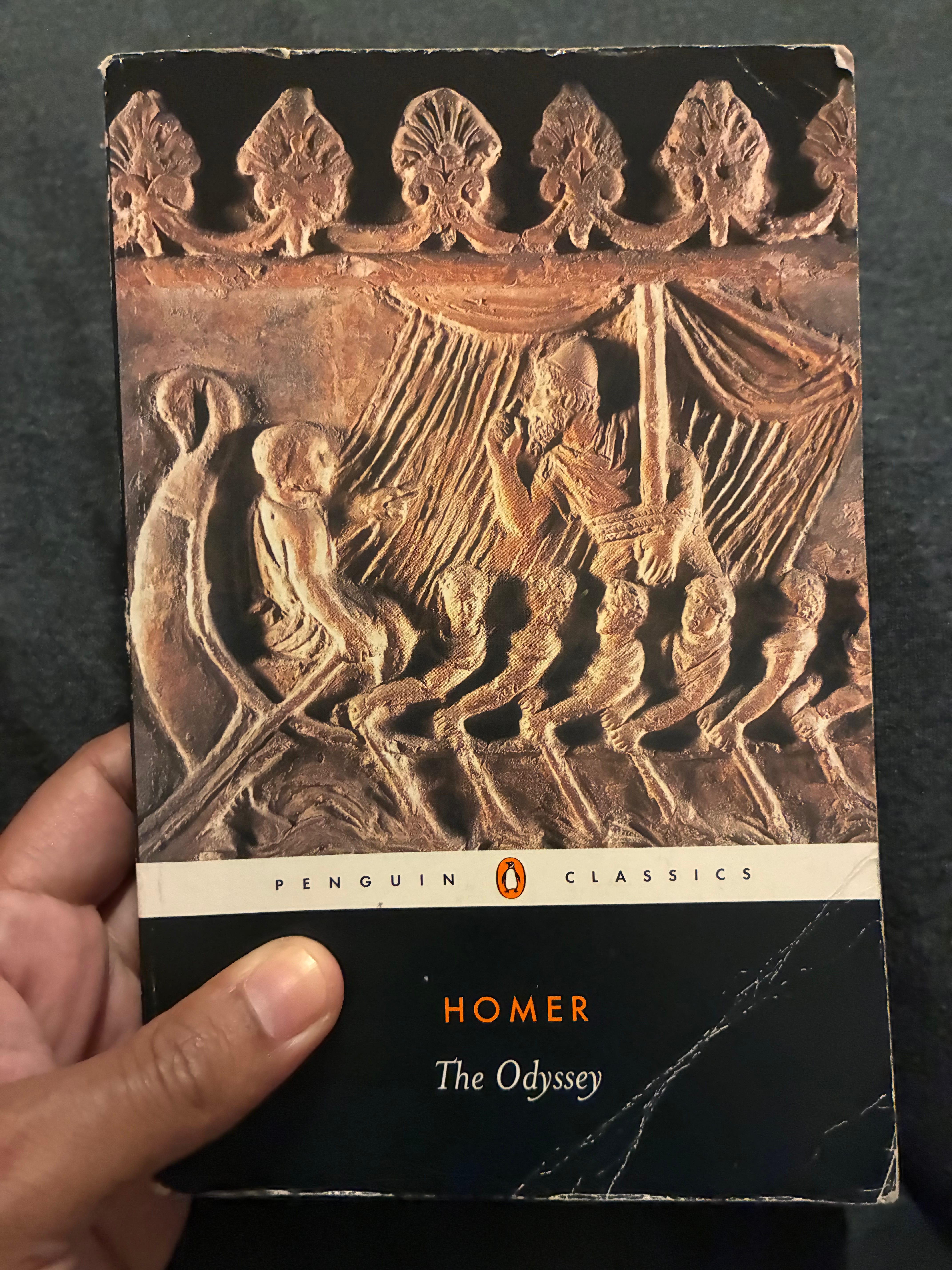
I read the Robert Fagles translation, a verse translation, of The Odyssey (Nov. 29, 1999. Penguin Classics. 541 pgs.) in the 2004/2005 school year as a high school freshman. That is enough time to appreciate Nolan’s film without glaring too hard at it. And now I hear the siren song of E.V. Rieu’s translation (1946 then Mar. 10, 2010, updated by his son D.C.H. Rieu. The first of the Penguin Classics. 416 pgs.), a prose translation, which has been sitting on my shelf patiently, till I watch the film.

And watch the film, by Chris Nolan, I did. Two words. First, because of the length of time since I read the book and the situation (high school) of my initial reading, these are terse reflections on the film itself and not the book. I will have to address the book at a later date. Second, I am predisposed to loving Chris Nolan for: Memento (2000), The Prestige, The Batman trilogy (aughts and teens), Inception (2010), and Oppenheimer (2023). The Prestige and Inception are in my top five all time, and all of these films place a high value on trickery and deception.
The Odyssey (2026. 2 hrs 53 mins.)
Let us quickly look at five things: Zeus’ law, Hades, the drinking of animals’ blood, blind sages, and vengeance.
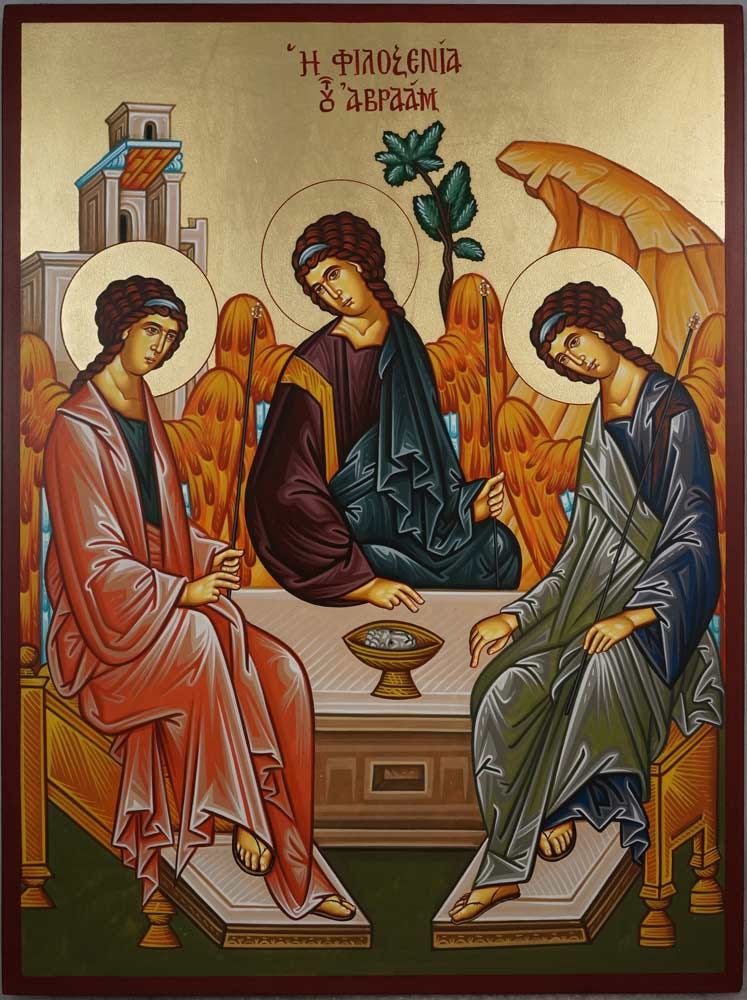
Xenia, the law of hospitality enforced by Zeus the skygod and father of all gods and goddesses in the Greek pantheon, with obvious parallels across all the Indo-European folk religions, is ripe for comparison and contrast with hospitality in the Hebrew Bible (Genesis 18:1-15), the Old Testament, and later the one, holy, universal, and apostolic church which gathered at Nicaea and Constantinople.
God appeared to him by the oak of Mambre, while he was seated before his tent at noon. Observe here the virtue of the righteous one. He was sitting in front of his tent. He practiced so much hospitality that he left none of his inferiors to take in strangers. This old man, who had three hundred and eighteen servants, who was overwhelmed by age, since he had reached a hundred years, was seated at his door to wait for guests. He put all his attention into it, without finding any obstacle in his old age or in the care of his repose; he did not lie inside, but sat at the door. Many others, far from having such care, seek instead to escape the sight and approach of strangers, for fear of being forced to receive them in spite of themselves. Such was not the righteous man who sat at his door at noon. For his hospitality and his virtue are all the more admirable as he stood at noon. That was right; he knew, in fact, that those who are forced to travel have, especially at this hour, need of assistance; so he chose this moment of the day and watched passers-by, putting his rest to relieve the fatigue of the travelers. He sought to shelter in his tent those burned by the heat, without examining the passers-by and not asking if they were known or unknown. For hospitality does not admit of such a search, it demands with all a benevolent tolerance, and, as he had displayed the net of hospitality, he deserved to receive the Almighty with his angels. So St. Paul said: Let us not neglect hospitality; it is by practicing it that some have received as angels hosts without knowing it (Heb. 13:2); it is clear that this is an allusion to the patriarch. So Christ said, “He who receives one of the least in my name, receives me.” (Mt. 18:5)
-St. John Goldenmouth
Although Abraham ran from the tent toward them as if toward strangers, he ran to receive those strangers with love. His love for strangers was thus proved by the haste with which he ran to meet those strangers. Therefore the Lord, who had just appeared to him at the door of the tent, now appeared to Abraham clearly in one of the three. Abraham then fell down and worshiped him, seeking from him in whom majesty dwells that he condescend to enter his house and bless his dwelling. “If I have found favor in your sight, do not pass by your servant.” God did not oppose him, for he said, “Do as you have said.” Then Abraham ran to Sarah [telling her] to make three measures of wheat, and then he ran to the herd to get a fatted calf.
-Lord Ephrem the Syrian
For comparison and contrast, we can ask Greek folk religion and Judeo-Christianity the following questions: What are the due measures and bounds of hosting guests and strangers and enemies? How does the duty of the host differ from the duty of the guest? And like Undercover Boss (2009), how would you act if the guest you are entertaining happens to be a god?
A principle of Rugby Football, as practiced at American universities, is hospitality toward your perceived enemies. No matter how much one side dominates another on the pitch, no matter what words are exchanged prior to the final whistle, after the game, both teams gather at a location the host team selects and on the dime of the host eat pizza and drink beer to their heart’s desire. In four years of collegiate Rugby, the bad blood of only one game we played led to no peace meal afterward.
The law must be honored.
Traduttore, traditore, a modern era Italian near homophone pair meaning translator, traitor, and the grandson of Jesus ben Sira, a translator, in the Old Greek of the Old Greek Hebrew Bible witnesses to the level of skepticism we should have of any translator. Trust me, I am a professional translator ;)
Many great teachings have been given to us through the Law and the Prophets and the others that followed them, and for these we should praise Israel for instruction and wisdom. Now those who read them must not only themselves understand them but must also as lovers of learning be able through both speaking and writing to help the outsiders. So my grandfather Jesus, who had devoted himself especially to the reading of the Law and the Prophets and the other books of our ancestors and had acquired considerable proficiency in them, was himself also led to write something pertaining to instruction and wisdom, so that by becoming familiar also with his book those who love learning might make even greater progress in living according to the law.You are invited, therefore, to read it with goodwill and attention and to be indulgent in cases where we may seem to have rendered some phrases imperfectly, despite our diligent labor in translating. For what was originally expressed in Hebrew does not have exactly the same effect when translated into another language. Not only this book, but even the Law itself, the Prophets, and the rest of the books differ not a little when read in the original.
(Sirach 1:1-25 New Revised Standard Version Updated Edition)
Hades in The Odyssey is a physical place reachable by boat, but also a metaphysical and supernatural place of the dead. Hades in the Hebrew Bible and the New Testament should not be interpreted in light of Greek folk religion. Instead, it should be seen as a translation of Sheol, the place of the dead in the Hebrew of the Hebrew Bible. Nevertheless, the way in which in the film it is an actual physical place grounded in reality from which the spiritual place of torment can be explained works well.
The ritual drinking of the blood of animals in order to speak in Hades gives us some of the greatest contrast between paganism and Christianity. Over the past year I have taught extensively on the Acts of the Apostles, Galatians, and Romans in my Sunday School and Summer Camp programs in the Ethiopian Orthodox Church. The crux of a dispute between Judean Christians and Gentile Christians, which in at least one case led to the dastardly neglect of widows (Acts 6:1), had to do with defining the necessary and sufficient conditions of being a Christian and keeping the five books of Moses. Twice in the first ever synodal meeting (Acts 15:19, 29) the Gentile Christians are commanded by their lords the Apostles, the Judean Christian leaders hand-selected and hand-picked by the Lord Jesus, to at least “abstain from things polluted by idols, from fornication, from things strangled, and from blood.” There is life in blood. And we should at minimum avoid drinking it and eating it.
In the film, we have the motif of blind sages in Teiresias, the prophet in Hades, and Eumaeus (played by John Leguizamo) the blind but loyal swine herder in Ithaca. The Ethiopian Orthodox Church has a history of making space for and highly valuing blind sages, as Odysseus (played by Matt Damon) does but the suitors fail to do. The Ethiopian Orthodox Church teaches that though their vision on the outside, the veranda, may be out, their inner lights shine bright, sometimes even brighter than normal. She places a high value on those who acquire wisdom through hardship. And even though it is easier today with all of the technology available, it is still not an easy task to do. And so their wisdom puts to shame all of us able-bodied believers, and should inspire us to greatness and excellence in seeking the Lord and pursuing him.


Spoiler Alert:
The film ends with the iconic plucking of the string of Odysseus’ bow, an instant classic cinematic meme (my favorite comparisons are to millennial dads being challenged by their children to play console shooting games and thus they pluck their controller, the sticks). This is a task only a great man like him could complete, and thus it verifies his identity to the mangy suitors and to his patient wife Penelope (played by Anne Hathaway). “To the one… the aroma of death leading to death, and to the other the aroma of life leading to life” (2 Corinthians 2:16 NKJV). Odysseus makes quick work of his enemies with his bow, with functionally no help from his son. It is a bloodbath. They never had a chance.
But “Beloved, do not avenge yourselves, but rather give place to wrath; for it is written, “Vengeance is Mine, I will repay,” says the Lord” (Romans 12:19 NKJV). And “When He opened the fifth seal, I saw under the altar the souls of those who had been slain for the word of God and for the testimony which they held. And they cried with a loud voice, saying, “How long, O Lord, holy and true, until You judge and avenge our blood on those who dwell on the earth?” Then a white robe was given to each of them; and it was said to them that they should rest a little while longer, until both the number of their fellow servants and their brethren, who would be killed as they were, was completed” (Revelation 6:9-11 NKJV).
“This is a hard saying; who can understand it?” (John 6:60 NKJV)
In the days of old, there were blog rolls. We do not really have that, but if we did, I would send you regularly to Jonathan Pageau, a friend of the show and the master of interpreting the symbolic world.

The ever astute Nicholas Nakis says Dunkirk is a must-watch. It is definitely on my list, I just have not gotten to it yet.